Announcement
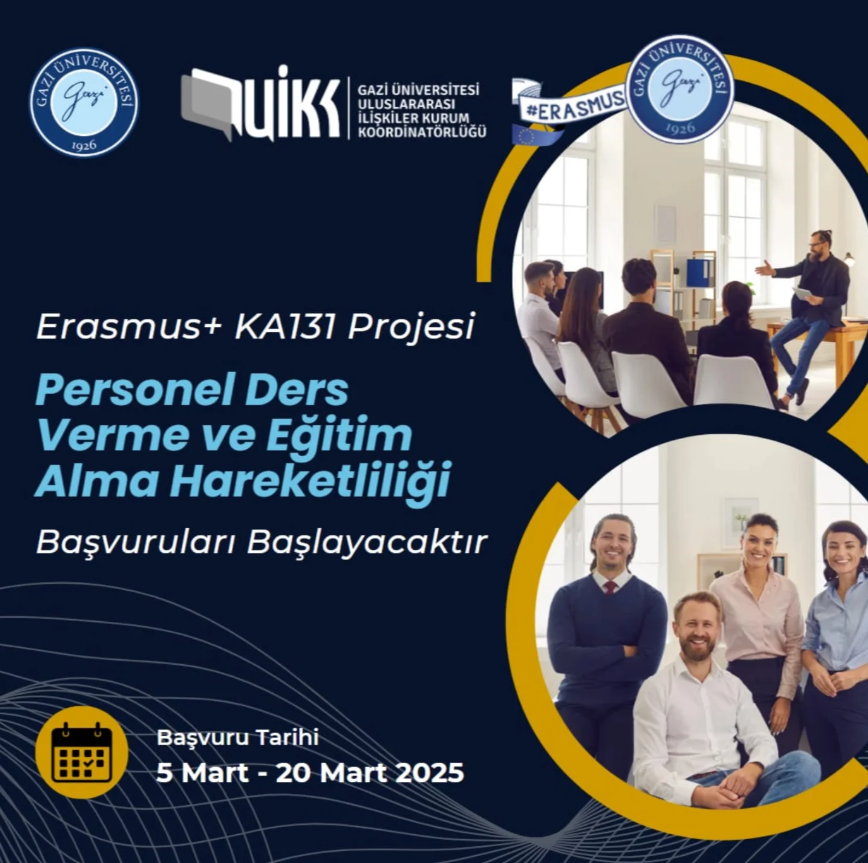
Applications for the 2024 Project Period Erasmus+ KA131 Staff Teaching Mobility Are Now Open
10 March 2025 | 10:59
2024 PROJECT PERIOD ERASMUS+ PROGRAM COUNTRIES (KA131)
CALL FOR APPLICATIONS FOR STAFF TEACHING MOBILITY
Application Period
5 March – 20 March 2025 (TRT 23:59)
Available Slots
The quotas for the 2024 Project Year Erasmus+ KA131 Project “Erasmus Staff Teaching Mobility” are open to all faculty members, lecturers, teaching staff of our University’s faculties, schools, and institutes, and to post-doctoral research assistants; a total of 4 persons.
There is no position requirement for personnel employed at the higher education institution; any staff member with an employment contract may participate. Personnel whose official position is at another institution but who work under contract at our University must apply through the institution where they actually work, not where their position is held. Personnel employed via service procurement, without a direct contract with the higher education institution, are not eligible for staff mobility.
Note: Two of these four slots will be funded from the budget of project number 2024-1-TR01-KA131-HED-000213752, titled “Erasmus Consortium Mobility Project.”
Staff teaching mobility is the activity that enables a staff member who is obliged to teach at a higher education institution in Turkey holding an Erasmus University Charter (EUC) to teach students at an ECHE-holding higher education institution in an EU member or program country and to carry out joint academic/educational activities with the host institution related to teaching.
Staff teaching mobility is a day-based activity, and grant payments are made for teaching days. Therefore, the teaching schedule must be specified on a day-by-day basis in the Staff Mobility for Teaching Mobility Agreement.
- Activity Durations for Erasmus Staff Teaching Mobility
In order to allow as many academic staff as possible to benefit from the program, our Erasmus Institutional Coordinatorship has decided to grant each selected staff member up to 7 days of funding. Successful candidates must complete their teaching activities by 31.07.2026.
A grant of 7 days is provided to participants (5 activity days and 2 travel days). The minimum duration for teaching mobility is 2 consecutive working days. Although the maximum duration of the activity is 2 months, our University provides a 7-day grant to participants. Furthermore, a minimum of 8 hours of teaching is required for the activity to be considered valid.
If the participation certificate shows that the staff performed the activity for less than 2 consecutive days (unless due to force majeure) and/or taught fewer hours than required, the activity is considered invalid and no grant payment is made to the beneficiary.
Provided that force majeure is documented, activities where the minimum duration cannot be completed are accepted; a grant is paid for the duration attended, and travel costs are reimbursed based on the distance calculator.
If the beneficiary both participates in the activity and travels on the same day, a one-day grant deduction is applied. Therefore, travel days and activity days should not coincide.
- Application Process
Academic staff wishing to apply for the “Erasmus Teaching Activity” must submit their applications between 5 March and 20 March 2025 (TRT 23:59). Applications submitted after 23:59 on Thursday, 20 March 2025 will not be accepted.
In order to benefit from the teaching mobility, an inter-institutional agreement between our University and the host institution is mandatory. You can access the list of our University’s inter-institutional agreements at
https://erasmus.gazi.edu.tr/view/page/98221. Additionally, the invitation letter obtained from the host institution must be submitted during the application process.
How to Apply?
- To apply for Teaching Mobility,
https://turnaportal.ua.gov.tr/giris is the portal where applications must be submitted online.
Application Documents:
- Invitation letter from the host higher education institution
- If available, a Foreign Language Certificate valid for 5 years [YDS, YÖKDİL, or any exam recognized as equivalent by ÖSYM]
- Disaster victim certificate issued by AFAD for staff or their first-degree relatives who are disaster victims
- Document proving the disability status of staff with disabilities
- Document proving the status of Gazi University staff, and spouses or children of martyrs and veterans
- Documents proving the work of staff members conducting activities related to artificial intelligence
Applications submitted with incomplete documents will be considered invalid.
Foreign Language Exam Provisions:
The equivalency table is available at the following link: https://dokuman.osym.gov.tr/pdfdokuman/2021/GENEL/esdegerlikdokuman06042021.pdf
A foreign language score is not mandatory for teaching mobility, but it is among the selection criteria.
- Evaluation Process
The primary document used in selecting staff wishing to benefit from mobility is the invitation letter requested during the application.
The selection is carried out among the applicants using evaluation criteria determined by our University, applied equally to all staff.
Erasmus+ Staff Teaching Mobility Selection Criteria
|
No |
Criteria |
Scoring |
|
1 |
Base Points |
20 |
|
2 |
First-time participation in the program |
10 |
|
3 |
Being the Erasmus+ Coordinator or Deputy Coordinator at Faculty/Institute/School/Vocational School/Department |
10 |
|
4 |
Applied last year and completed all procedures but could not participate due to force majeure (e.g., health issues; requires petition) |
10 |
|
5 |
Selected last year but withdrew without justification other than the above reasons |
-10 |
|
6 |
First staff member from their unit to benefit from the program |
5 |
|
7 |
Having a physical disability (with document/report) |
5 |
|
8 |
Being Gazi University staff or a spouse/child of a martyr or veteran (with document)1 |
5 |
|
9 |
Being a citizen of the host country |
-10 |
|
10 |
Benefited from the program last year |
-10 |
|
11 |
Benefited from the program two years ago |
-5 |
|
12 |
Benefited from the program three years ago |
-4 |
|
13 |
Previously benefited from the program |
-3 |
|
14 |
If Foreign Language Education Department staff and language score is between 86–90 |
4 |
|
15 |
If Foreign Language Education Department staff and language score is between 91–95 |
6 |
|
16 |
If Foreign Language Education Department staff and language score is between 96–100 |
8 |
|
17 |
If staff from another department and language score is between 71–80 |
4 |
|
18 |
If staff from another department and language score is between 81–90 |
6 |
|
19 |
If staff from another department and language score is between 91–100 |
8 |
|
20 |
Receiving disaster relief from AFAD for themselves or a first-degree relative |
5 |
|
21 |
Conducting AI-related activities under the 2021–2025 National AI Strategy by the Presidency’s Digital Transformation Office (must be clearly specified in the invitation letter)2 |
5 |
|
22 |
Conducting mobility with a country and institution not previously visited |
5 |
1 Priority is given to combat veterans and their spouses and children, spouses and children of war martyrs, as well as those defined in Article 21 of the Anti-Terror Law No. 3713 dated 12/04/1991—“public officials who, while performing their duties at home or abroad, or even after their positions have ceased, were subjected to terrorist acts resulting in injury, disability, death, or being killed”—and to spouses and children of those who died or were disabled as a result of the 15/07/2016 coup attempt and associated terrorist acts under Decree Law No. 667 dated 23 July 2016, when applying for Erasmus staff mobility.
2 https://cbddo.gov.tr/SharedFolderServer/Genel/File/TR-UlusalYZStratejisi2021-2025.pdf
For academic staff with equal scores, academic performance criteria and the seniority criteria at Gazi University will be used in selection.
Announcement of Selection Results
Selection results will be announced on the website http://erasmus.gazi.edu.tr/.
Appeal Against Selection Results
Applicants who wish to appeal the selection results must submit a petition to our unit within 1 week after the results are announced.
- Grants
The grant provided to staff mobility participants is a contribution and does not cover all costs incurred during the period abroad.
The daily grant amount for staff participating in mobility is calculated based on the host country and duration, using the amounts shown in the table below. All amounts are in Euro.
Daily Grant Amounts
|
Country Groups |
Host Countries |
Daily grant amounts (Euro) |
|
Group 1 Countries |
Germany, Austria, Belgium, Denmark, Finland, France, Netherlands, Ireland, Italy, Sweden, Iceland, Liechtenstein, Luxembourg, Norway |
171 |
|
Group 2 Countries |
Cyprus (Southern), Spain, Malta, Portugal, Greece, Czech Republic, Estonia, Latvia, Slovakia, Slovenia |
153 |
|
Group 3 Countries |
Bulgaria, Croatia, North Macedonia, Lithuania, Hungary, Poland, Romania, Serbia |
133 |
Participants’ activity durations and grants are estimated before the activity. After completion, actual durations and grants are recalculated. No grant is paid for days without activity or without documented appropriate activity. One travel day before and one after the activity may be eligible for individual support.
Travel Grant Amounts
Travel expenses for staff mobility are calculated using the European Commission’s “Distance Calculator,” available at:
http://ec.europa.eu/programmes/erasmus-plus/tools/distance_en.htm
Using the distance calculator, the distance in km between the participant’s residence and the activity location is determined, and the travel grant is calculated from the table below. The distance calculator value corresponds to the round-trip grant amount in the table and is not doubled. Indirect travel does not affect the calculated distance. Travel grants are paid as a lump sum.
|
Travel Distance |
Standard Travel Grant Amount (Euro) |
Green Travel Grant Amount (Euro) |
|
10 to 99 KM |
28 |
56 |
|
100 to 499 KM |
211 |
285 |
|
500 to 1999 KM |
309 |
417 |
|
2000 to 2999 KM |
395 |
535 |
|
3000 to 3999 KM |
580 |
785 |
|
4000 to 7999 KM 820 |
1188 |
1188 |
|
8000 KM or more 1500 |
1735 |
1735 |
As a general rule, for distances under 500 km, participants are expected to travel by low-emission means. The starting point is assumed to be the sending institution’s location, and the activity location is the host institution’s. If the departure or activity location is in a different city, causing a different distance band, travel invoices must be provided and the grant paid according to the actual band. If a different departure or location is reported, the reason must be documented, and travel documents and invoices showing start and end points must be kept in the personnel file for audit purposes.
Beneficiaries demonstrating that the travel grant covers less than 70% of their total travel expenses may request exceptional travel support, not exceeding 80% of total travel costs. However, no additional distance-based travel grant will be paid in this case. Otherwise, as the travel grant is paid as a lump sum, documents need not be kept. Participants choosing Green Travel may receive individual support for up to 6 travel days.
Payments to Staff and Deductions
Grants are paid in Euro. If the activity does not take place, no grant is paid and any paid amount is reclaimed.
If participation proof (certificate) is not submitted, mobility is invalid and the grant is reclaimed. Grants for incomplete or inappropriate activities are also deducted.
Except for technical reasons, participants who do not complete the survey will incur a 20% deduction of the total actual activity days and the distance-based travel grant.
Zero-Grant (“0” Granted) Participation
Staff may participate without receiving a grant. To do so, they must apply and be evaluated with other applicants.
Zero-grant participants are not included in budget calculations and receive no payment. Not receiving a grant does not exclude them from selection.
Returning Before Planned Activity Period Ends
Mobility periods shorter than the minimum due to non-force majeure are considered invalid and no grant is paid.
If staff return early due to documented force majeure, they are paid the daily grant and distance-based travel grant for days spent abroad. Any overpayment must be refunded.
Staff who cannot complete the minimum two days (excluding travel) due to force majeure may be allowed to make up the activity within the same contract period by signing a new teaching/training mobility agreement, without a new selection process. However, staff who leave early for personal force majeure reasons beyond the minimum duration are not allowed to return for makeup activities.
Inclusion Support
The Erasmus+ Program encourages participation of individuals with fewer opportunities. Participants with special needs who require additional financial support due to physical, mental, or health conditions may request additional support after selection by estimating extra costs and applying to the National Agency.
Staff requiring Inclusion Support must upload supporting documents in the online application system. For example, for disability support, a medical report specifying the disability level (not older than 3 months) or a copy of the disability card; for chronic illnesses, a doctor’s report is required.
Being a Citizen of the Host Country
Staff may participate in a country of which they are citizens; however, they will receive lower priority in the evaluation.
Other Announcements
Compulsory English Courses Exemption Exam Results – 14 October 2026
GAZI21: 21st Century Skills and Social Entrepreneurship Training Program for Young People
2026–2027 Academic Year Meal Scholarship and Part-Time Employment Applications Are Still Open
Common Courses Midterm and Make-up Exam Schedule